
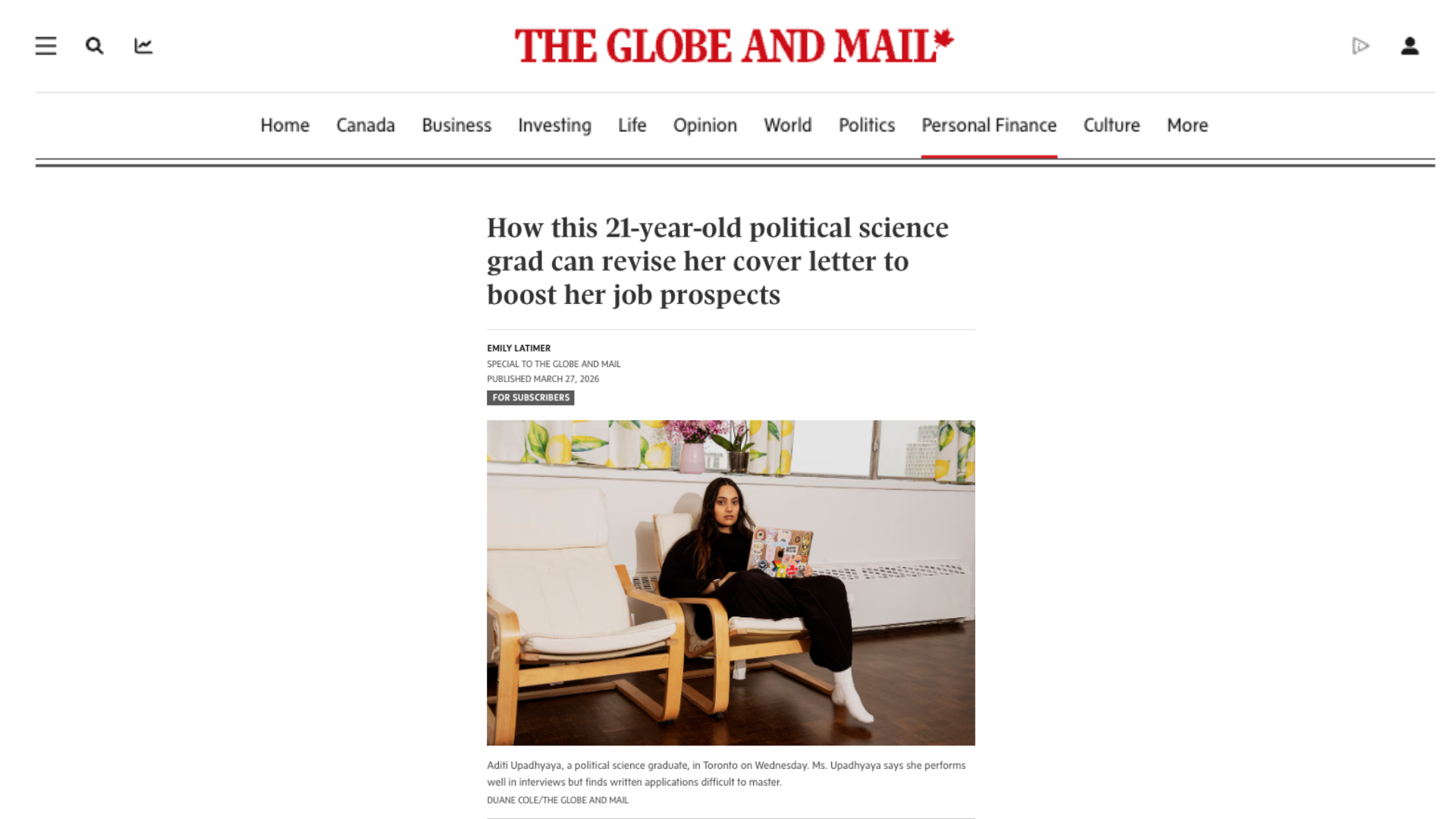
Talking cover letters with The Globe & Mail
It’s a difficult time to find work, especially as a new graduate. Last month, Emily Latimer, a freelance journalist working The Globe & Mail, interviewed me for a series she’s writing to help new graduates find jobs.
The article is behind a paywall for Globe subscribers (I am one), but I’ve clipped some of the relevant sections.
EDITORIAL NOTE: To prepare for my chat with Emily, I also talked with four public policy professionals about how to break into their field, and I’ll publish that piece about their advice shortly.
For the article, we looked a cover letter and resume submitted by Aditi Upadhyaya, a 21-year-old new graduate in political science from the University of Toronto. She’s interested in a career in public policy.
Her search so far:
Since graduating in the fall of 2025, Ms. Upadhyaya has applied to hundreds of jobs but has received only two or three interview opportunities. She spends at least an hour every day on LinkedIn looking for roles, applying and connecting with people. She landed her current short-term contract position at a non-profit through a cold connection on LinkedIn. However, that’s expected to wrap up at the end of March. As her three-month contract comes to end, she is looking for something long term.
Her story is typical of many of my clients. Yield from online applications alone is low volume in 2026, though warm introductions from networking can help your resume get to the top of the pile.
In many cases, my clients have more success when they connect with people 1:1 and build a networking strategy. I was encouraged when Emily told me that Ms. Upadhyaya is also networking in person.
That’s so important, and a step a lot of people skip!
Cover letters are daunting, even for people who write for a living
Real talk: I hate cover letters. They’re my least favourite piece of the job application package.
Upside to writing one anyway: They force you to think about what the company wants and why your skills and experience mean you’re a fit for their team.
Here’s Ms. Upadhyaya told the Globe about her job search so far:
Writing cover letters can be time-consuming so Ms. Upadhyaya has a method: For each application, she reviews the job description, highlights the required skills and experience, and emphasizes the most relevant points in the cover letter, instead of repeating her résumé. Still, she suspects there’s something that she’s not doing right.
“I feel like I’m not able to translate the experience and skills I have in a way that completely aligns with what the job is asking for,” she said. “I know it has to be reframed in a certain way to match whatever it is they need, but it ends up sounding more generic than specific.”
Tailoring your letter to the role is another solid strategy. I read Ms Upadhyaya’s cover letter, which I won’t share to protect her privacy. It was strong, but a touch on the long side.
In my conversation with Emily, most of the things I suggested made it into the piece, but we didn’t talk about the structure of a cover letter.
A cover letter’s four-part structure
- Opening pitch: Which role you’re applying to, how you heard about it, and why you’re qualified (in a nutshell). I recommend clients use their one-sentence pitch in this paragraph. You can include years of experience in this area if you wish.
- Second paragraph: What’s the most relevant experience you have to leverage with the new employer? The best letter I ever wrote was for a communications job with York University. I explained my track record working for the University of Toronto in a similar capacity. I invited them to consider my successes and how my knowledge of their sector and biggest competitor meant I could help them succeed (I got the interview and the job).
- Third paragraph: Other experience or education that would be relevant to the role. Be concise and result-driven where and when you can. If you don’t have a lot of work experience, you can combine paragraphs two and three.
- Closing: What appeals to you about the company, the ways you anticipate you’ll grow in this role and why they should consider you as a candidate. A lot of letters skip this section or write something too generic. As a hiring manager, I want to see your attempt to understand our problems, even if your knowledge isn’t as deep from the outside. Show me that you understand a little about our business and how you might help us.
Talking cover letters: Lead with your results-based success
As Emily writes: “As the job market becomes more competitive, application materials are shifting to results-based storytelling. Ms. Monier-Williams suggests always thinking about the “so what?” factor. Directly mention the impact of a particular campaign, promotion or event you were involved in.”
Here are some other points I made:
Before drafting any application materials – whether it’s a portfolio, résumé, cover letter – applicants should develop three key talking points for every job that helped them qualify for the position, said Ms. Monier-Williams. “You should know those three points inside out and backwards,” she said.
This approach keeps applicants consistent across interviews, cover letters and while selecting portfolio pieces.
Job seekers should [also] highlight the results of what they’ve done. For example, if you organized an event to support an initiative, you should include details about what was required and the wins for the organization.
“Tell me what’s the scale and scope of things you’ve touched,” Ms. Monier-Williams said. “That tells them about the throttle you can handle. What can we throw at you that you’ve already seen, so you’re not going to be fazed by it?”
Instead of mentioning “diverse teams and external stakeholders,” be specific. Is it a 10-person or a 60-person team? How many projects have you managed? What were the outcomes of those projects? “As much as you can, put numbers, scale, and scope, so people can see what you bring to the table,” she said.
This mindset gets taught early to marketers since it’s a profession hired on our ability to generate revenue. That storytelling is more convincing when you have the digital receipts to back up your work.
For example, I met Leilani Bruce through Growclass and I reference her SEO portfolio ALL the time. It’s hard to say no to a gold standard case study like this one.
Software engineers, designers, game developers and communicators are also professions used to presenting their work in a portfolio style.
In a competitive market, it’s a perspective and approach that may help you stand out from the crowd.
Stuck in a job search? My fresh eyes can help
Book a 15-minute, No Charge Exploratory call.



01 Comment
Not ghosting you, I promise - Elizabeth Monier Williams
04 April, 2026[…] days ago, The Globe and Mail published a great article mentioning my career strategy practice. Being in Canada’s national newspaper was awesome. I’m still excited that it […]
Comments are closed.